


Page 22 - Mobility Management, August 2018
P. 22
                                Case Studies
Finding the Right Fit
thought might involve how to seat him so he’s stable.
That was certainly one consideration for the Sunrise Medical
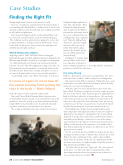
team working with Mark Holbert, a member of the United States Army Special Forces who lost both legs after stepping on an IED in 2010 while in Afghanistan.
But it wasn’t the biggest task the seating and mobility team faced. Instead, said Jesus Ibarra, Associate Product Manager, “The challenge was that sometimes he’s going to be in the chair using his prosthetics, and other times he would not be. So we had to find a balancing act between those two positions and distributions of weight and load.”
With & Without Prosthetics
Angie Kiger, M.Ed., CTRS, ATP/SMS, Clinical Strategy & Education Manager, provided additional details, including that the IED that injured Holbert resulted in a very high-level amputation. “It’s a difficult prosthetic for him to wear and stand on [on the
left side],” she said. “The other amputation is right at the knee. So Mark primarily wears his prosthetics at work and when he rides his motor tricycle. Every time I saw him at his house, because I was part of the photo shoot team, he was out of his prosthetics.
“I asked Mark, and he said, ‘When I’m at home, I rarely wear
It’s more of a pain for me to take off the wheels and play Tetris putting the chair in the trunk — Mark Holbert
them.’ He’s not been able to find ones that fit well.”
Kiger and Clinical Rehab Manager Robert Agostino inter-
viewed Holbert for more details, such as how often he wears his prosthetics, where he usually wears them and how much they weigh. Holbert’s chair would need to fit and work efficiently, regardless of whether or not prosthetics were present.
The seating and mobility team chose Sunrise’s new Xenon2
folding ultralightweight wheel- chair with a fixed front. “What I found refreshing about this chair is it gives us the ability to play with the back angle, which isn’t a very common feature on a folding frame chair,” Agostino said. “Typically, folding-frame chairs have a fixed back angle, and there’s little you can do with it. But with the adjust- ments on the Xenon2, you do have the ability to play with your back angle.”
Building in 1" of dump helps
to keep Holbert stable in his
seat, regardless of whether or
not he’s using his prosthetics — he weighs 180 lbs. without his prosthetics and 200 lbs. with them.
U.S. Army Strong
Holbert, a government contractor, is a frequent flyer. He’s also a trike rider and a triathlete. And he still prefers a folding frame.
Kiger reported that Holbert explained, “Folding for me is easier for transport, especially when I am traveling by myself. And my motorcycle is set up for a folding chair.”
“When he drives, he wears his prosthetics most of the time,” Kiger added. “He drives an adapted van, but he stands up to put the chair in his vehicle. [The chair] has got to be lightweight; he’s kind of off balance when he’s in his prosthetics. He’s not overly stable on them; he doesn’t take a whole lot of steps on them. He wants to be able to grab the chair and throw it into his van very easily. He’s said, ‘It’s more of a pain for me to take off the wheels and play Tetris putting the chair in the trunk or back seat.’”
Have folding frame designs shaved enough weight to make them competitive with rigid frames when it comes to transport? Kiger believes the industry “is getting there. We’ve been telling people for years that they’ve got to have a rigid. But the reality is some folks prefer folding — whether it’s because of the swing- away mechanism for the legrests, or they’ve just always been in a folding, or they want it for the convenience of a smaller vehicle. Now with an option like the Xenon2, we don’t have to say, ‘We’ve got to put you in a rigid.’”
For the record, the footrest on Holbert’s chair locks into place and pops out when it’s time to fold the chair. Also for the record, Holbert has had a rigid frame before, and he’s had a folding frame before the Xenon2. In the end, the combination of fold- ing-frame convenience in a lighter-weight design that includes a fold-down back won Holbert over.
“He said he likes it for travel,” Kiger said. “He scoots forward in his chair — he likes to be able to change position a little, depending on whether he has his prosthetics on or doesn’t. It was a personal preference for him.” m
  20 AUGUST 2018 | MOBILITY MANAGEMENT
MobilityMgmt.com


