


Page 10 - Mobility Management, August 2018
P. 10
                                mm beat
Expansion News
Altimate Medical Acquires Activeaid
 Altimate Medical has acquired Activeaid Inc., which will continue to operate independently.
In a news announcement of the acquisition, Altimate noted that the two companies “have shared synergies
in the marketplace, and both product portfolios comple- ment and strengthen each other.”
Activeaid, which was founded in 1965 and is head- quartered in Redwood Falls, Minn., specializes in bath and hygiene systems. Activeaid’s product line includes raised toilet seats and bathtub chairs. More complex Activeaid products perform multiple functions, such as serving as a commode and a shower chair.
Some Activeaid products also offer tilt and recline capabilities. The company produces products for pedi- atric, adult and bariatric clients.
“The diverse product lines, proudly made in the USA, address a range of users, from daily care assistance
in the home environment to products designed for the
hospital and institutional market,” the news announce- ment said.
Todd Tholkes, Altimate Medical’s CEO/President, takes over as the head of Activeaid.
“Activeaid has been a
strategic partner to Altimate
Medical for 30-plus years,
and we look forward to
leveraging some of Altimate
Medical’s strengths to sustain
and help grow the Activeaid business,” Tholkes said.
“We would like to thank each of the team members of Activeaid for their contributions toward its mission over the last 50-plus years, and we look forward to an exciting future.” m
Study Examines Sleep Apnea Prevalence in Patients with Quadriplegia
More than 70 percent of people with quadriplegia also have obstructive sleep apnea (OSA), a disorder in which the upper airway narrows and closes repeatedly while people are asleep.
A new study in The Journal of Physiology sought to understand why.
Researchers wanted to know how throat muscles are impacted by quadriplegia. In sleep labs in Sydney and Melbourne, Australia, they tested volunteers who had sleep apnea. Some of those volunteers also had quadriplegia.
A breathing mask was used to simulate the narrowing of the airway that is characteristic of sleep apnea. Electrodes inserted into the genioglossus, the largest muscle that surrounds the upper airway, measured reflex responses to the airway narrowing.
Researchers expected that those reflexive responses would be similar for volunteers with and without
8 AUGUST 2018 | MOBILITY MANAGEMENT
quadriplegia, since those researchers thought quadri- plegia didn’t affect a patient’s airway.
Instead, study results showed in some people with quadriplegia, “Key protective throat reflexes were absent, or indeed led to the switching off (instead of activa-
tion) of the genioglossus muscle. These findings help to explain why OSA is so common in those with tetraplegia and sleep apnea.”
The study was done on volunteers who were awake at the time, so researchers can’t say whether or not those reflexive responses would be the same when volunteers were sleeping.
“Regardless,” researchers said in a study announce- ment, “observations provide valuable insight into upper airway reflex responses, and pave the way for future physiological sleep reflex studies looking to develop effective and tolerable targeted therapies for those with [quadriplegia] and sleep apnea.” m
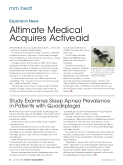
Activeaid’s 285TR model tilts up to 40°, reclines, accommodates up to 350 lbs., and has tool-free, four-way seat direction and height adjustability.
 MobilityMgmt.com


